Video
Capital Conversations – NT Wright | Women in Ministry, Faith & Politics, Current State of The Church
Resume
Dr. N.T. Wright diskuterer kvinders rolle i kirken og den nuværende tilstand i kirken i relation til politik og tro. Han fremhæver, at mange i dag stadig mener, at Bibelen begrænser kvinders mulighed for at lede og undervise i kirken, men han argumenterer for, at dette ikke er tilfældet. Wright nævner to centrale kvinder fra Det Nye Testamente: Phoebe, som bragte Paulus' brev til romerne, og Maria Magdalena, der blev den første til at annoncere Jesu opstandelse. Disse eksempler viser, at kvinder har haft betydningsfulde roller i den tidlige kirke. Wright adresserer også 1. Timotheus 2,12, hvor Paulus siger, at kvinder ikke må undervise eller have autoritet over mænd. Han forklarer, at de græske ord for "undervise" og "have autoritet" kan tolkes på forskellige måder og peger på, at konteksten i Efesus, hvor kvindelige præster var almindelige, kan have påvirket Paulus' ord. Desuden diskuterer Wright, hvordan kirken kan forholde sig til den politiske polarisering i dag uden at blive partisk. Han understreger, at Jesu budskab er politisk, men at det redefinerer magt og autoritet gennem tjeneste og ydmyghed. Wright opfordrer til enhed blandt kristne på tværs af traditioner og understreger vigtigheden af at prioritere de marginaliserede i samfundet. Han afslutter med at bemærke, at Paulus ville være både opmuntret af mangfoldigheden i kirken i dag, men også bekymret over den manglende enhed.
Læs transskription
Would you thank Dr. RIGHT FOR uh Dr. Wright, you should know we are not a clapping church. They don’t do that for me. And don’t do it next week to be cheeky. Okay. You’re going to do that next week, aren’t you? Oh, good night. Um well, >> thank you, >> Dr. Wright. cut his sermon a little shorter than I even wanted because I could do this all day. But it was to give us an opportunity to ask him a few questions. And I’ll tell you, I I want to start with uh I want to start with a big one. It’s been something that’s been on my heart for a number of months to teach here in our church community and I haven’t found the right moment to do it with what we were doing with this James series and the like. So, here it is. Many of us here, many of my friends, uh, some watching online grew up hearing that the Bible restricts women from leading and teaching in church. Now, you’ve read the same Bible, but come to a different conclusion. Uh, make the case for it. What what does the Bible really say about women leading among God’s people? >> Everywhere I go in America, people ask me this question. >> Honestly, it’s getting worse right now. >> I understand. I I I hear that. I hear that. I’m sorry about that. Um, we in the UK tend to say we had this argument about 35 years ago and we more or less sorted it. Well, not quite, but we more or less sort it. But anyway, whenever I’ve had to make the case in the UK, as I’ve done many, many times in general sinned, in diosis and events in parishes and so on, I start with two women who are prominent in the New Testament. One is Phoebe, who I mentioned before. When Paul writes Romans, he gives the letter to an independent businesswoman who lives just east of Corinth because she’s going on a a business trip to Rome and she is going to take the letter. That in itself is a bit shocking to some people. Romans is one of the greatest pieces of writing ever of letters or anything. It’s an extraordinary document. Who you going to give it to? Well, some senior apostle. Well, no, actually it’s Phoebe. She’s on this trip. She’ll do it. When in the ancient world somebody took a letter to somebody else, especially a group of people, almost certainly nothing ancient history is 100% certain, but this is probably 90%. They would be the ones who would read it out. And when people said, “Excuse me, what did that mean?” They would also be the ones who would explain it. So the high probability is that the first person to do public exposition of Paul’s letter to the Romans was a businesswoman from east of Corinth. >> Now that already blows people’s minds. The other woman to whom I turn in this question is Mary Magdalene in John 20. Mary Magdalene through her tears comes to recognize Jesus. And Jesus wants her to go and tell all the others that he’s not only risen from the dead, but that he’s ascending. In other words, he is now the world’s true Lord. Everything is now under him, under his lordship. So, what does he say? Okay, Mary, I’ve got this important announcement that’s got to be made, but it’s so important. please will you go and get Peter or John or somebody because obviously it’ll have to be done by them. No, he says you go and now let me tell you the announcement that the crucified Jesus is alive again and he’s Lord of the world that is the foundation of all Christian gospel preaching and the first person to do that job is Mary Magdalene. >> Mic drop. >> Okay. Okay. I got a hard one for you. We’re going to stay on this topic. >> 1 Timothy. >> Yeah. >> Chapter 2, verse 12. I want to read it for my friends here. Paul writes, “I do not permit a woman to teach or to assume authority over a man. She must be quiet.” >> Can you help us make sense of this one? >> Yeah. >> Curiously. very curiously, but in the strange providence of God, these things happen. That was one of the passages that was in my morning reading about four hours ago when I got up. Just so happens I work through the New Testament on a regular basis. And uh I’m very much aware because this has been obviously hugely contentious that as a New Testament scholar, I study the text in Greek. I look up the Greek words in the Greek dictionaries and I see what’s going on. And the problem is that the Greek words for teach and particularly have authority are very contentious. The word for have authority seems to mean user authority or kind of elbow her way in. There’s various things to be said about that. One is Timothy seems to be in Ephesus. Ephesus was a town with a massive female-based religion. The religion of Artemis. The priests were women. um in Ephesus that was how things were done. The religious leaders were women. And it looks as though he may be saying, “I don’t want people in the church to start saying, um, okay, we need women to push the men out of the way and to take charge.” That’s possible. I mean, as with many other things in the New Testament, there are different possibilities. Um, another possibility is that when he says usering the authority of a man, it may mean of the husband that the wife must not user the authority of the husband and that needs to be teased out as well. But the keeping silent um the Greek word is and it’s that’s it’s a word for having leisure and the point about having leisure is that that’s what scholars have. That’s how you learn things. you’ve got the time off from work or domestic duties to be able to learn things. And so um and you you’ll have seen this in my commentary and and various other places. Um so it looks as though he may be saying let’s be careful how we do this but the women must have the leisure to do the necessary study etc. Not so that they can elbow the men out of the way but so that uh the church may proceed in the way that it should. The the parallel there actually is the passage in Luke’s gospel where Jesus is visiting the home of Mary and Martha and remember how it goes. Mary is sitting sitting at Jesus’ feet and Martha is crossed cuz she’s doing all the work in the back kitchen. And she says to Jesus, “Come, tell her to come and give me a hand.” And Jesus says, “No, she’s chosen the good part.” Now, what’s the point? In an ancient um Judeaic house, the back quarters would be where the women did all the stuff, and the front room was where the men would gather. And particularly they’ve gathered to hear Jesus. And the reason you sit at Jesus’ feet is not to gaze at him adoringly as though you got a crush on him or something. Well, that might be so too, but um but because you are training to be a a teacher yourself. You listen in order to learn. Mary has chosen the good part. She’s now with the men in the male space, which is the learning in order to teach space. And so it could go on. I mean there’s several arguments there but if you if you want to follow that up oh dear there’s a book which I have which is a collection of essays called surprised by scripture and that has a lot of the detail on the uh Timothy passage in >> I believe it’s chapter four of that book you you know you know it better than I do you know thank you so that that’s where I would start but I would always start with Phoebe and and with Mary because it’s pretty clear what’s going on in both of those cases. >> Well this is powerful. Okay. Um, I didn’t take questions because I would have been >> sure >> uh assaulted, but I I did I did get a question for you that was texted to me by our friend John Ortberg. I’m just going to read it. He says, “With all the political polarization going on in America, how does the church point to Jesus and his values without getting partisan?” Now, friends, I know I’m going political, but we can blame John Orberg if this all goes off the rails. Really, I want to hear what you have to say about this one. What do you think? Jesus himself was always in danger of being accused of being political because anyone who strides into a Galilean village in roughly 30 AD and says it’s time for God to become king. Well, we’ve already got a king. He’s called Herod. He lives just around the corner. He better not hear what you’re saying cuz he’s not going to be pleased. And there is a big fat king sitting on a throne in Rome and he especially won’t like it if you say it’s time for God to become king because we know what that means. Means revolution. I mean, the gospel is political. Face it. It’s about God reorganizing his world. God taking control of his world. The problem is that we today think of political as being about power games as they did in the ancient world. Whereas Jesus is constantly redefining power itself. And that’s really scary for the power brokers because they don’t know what to do. And so, I think I quoted it in the meeting we were in last night. When James and John say, “We want to sit at your right and your left hand in your kingdom.” They’re thinking Jesus is going to be like a new Herod only more so uh but without the marital complications hopefully and that um uh they will be at his right and his left like his home secretary and his foreign secretary or whatever you’d call them in your country, the secretary of state and the uh something or other. I don’t know. Um we we >> even that’s political at this point, but I’m not going to go there. And Jesus says, “Listen, the rulers of this age get their way by bullying people, by bossing them about, and by shouting at them and beating them up. We’re not going to do it that way. The one who wants to be great among you must be your servant, and the one who wants to be first must be slave of all because the son of man hasn’t come to be served as though he’s some great, high, and mighty potentate, but to serve and to give his life as a ransom for many.” And this is exactly cognate with the whole of the sermon on the mount where Jesus is redefining what power is all about. Blessed are the the meek, the mourers, the hungry for justice people, the the merciful, etc., etc. The world says, “No, no, no. Blessed are the the powerful and the rich and the and the popular and the this and the that cuz they’re going to muscle their way through.” And Jesus stands all that on its head. Now, any Let me just say this. I would say it in my own country and I’ll say it in yours. Any country with any pretensions to be a Christian country ought to say number one priorities read those biatitudes in Matthew 5. Number two, read the Nazareth manifesto in Luke 4. Um number three, read what Jesus says to John the Baptist in Matthew 11. When John the Baptist says, um, “Are you really the coming one or should we look for somebody else?” Jesus quotes Isaiah 35 and he says, “Just go and tell John what you see and hear. The blind are seeing. The deaf are hearing. The lame are walking. The dead are being raised. Something new is happening in God’s world. It doesn’t look like the normal revolution, but those are the things that count. Those are the signs of a community that’s following Jesus. That it makes the poor and the marginalized and the widows and the orphans and the strangers and so on. Makes them the priority. and the little children makes them the priority and and warns the power brokers and the bullies that God’s got their number and that that is not the way to be human, let alone to be the people of God. >> I wasn’t being political. I was merely telling you what’s in the New Testament. I’m just going to tack on to this. In your very timely book, Jesus and the Powers, you make a statement. I just want to hear you say a little more about it. You say, “The kingdom is not from the world, but it is for the world.” Say more. >> There’s a there’s a sentence in John’s gospel where Jesus I mean, the center of Christian political theology, as far as I can see, is John chapters 18 and 19. Because there you’ve got Jesus as the representative of the kingdom of God, arguing with Pontius Pilate, the representative of the kingdom of Caesar. And what are they arguing about? They’re talking about kingdom and truth and power, which are still pretty relevant concepts for us today. Truth, especially in postmodernity and with fake news and goodness knows what. But then uh Pontius Pilate says, “Are you a king?” And Jesus says, “My kingdom is not from this world.” that’s regularly been mistransated as to say, “My kingdom is not of this world.” In other words, oh, it’s not worldly. It’s a purely spiritual thing. It’s all about us having faith in the present and going off to heaven in the future. No, the Greek is ectosmut. My kingdom does not come from this world. He says, if my kingdom was of the worldly type, my friends would be fighting to stop me being handed over. Isn’t that interesting? The worldly kingdom gets its way by fighting. Jesus kingdom which is for this world has a completely different modus operandi which is why ironically when pilot sends Jesus to the cross Jesus says the work is complete it’s done it’s finished this is the completion of God’s work now it’s time for the new world to begin which is John 21 again >> our world needs us like we need oxygen am I right >> our nation needs this >> make it So Lord, okay, I we only have time for one more. And so um here it is. The Apostle Paul wrote to churches scattered uh across the ancient world. Now if he could see what has become of the church today, what would encourage him? What would grieve him? I I think Paul will be hugely encouraged by the multiple thousands of different ways in which people from all sorts and conditions and colors and backgrounds are coming together in worship. I I confess I just sat in the front row there with your worship team here and it it’s not quite my style of music, but that’s fine. We all have different styles, but the the diversity and the and the harmony and so on, that was that was music to my theological ears and it would be to Paul. And I’ve seen this reproduced in churches in many parts of the world and and happily in my own country as well. That’s that’s wonderful. What would astonish him, horrify him would be not just that we are disunited as a global church, but that we don’t care. So we start churches without any thought that down the road there is another group of people who are trying to worship Jesus. We we don’t need them and they don’t need or so it seems. the idea of being able to worship Jesus. And this, you see, this is the agenda of Romans 14 and 15. Most people reading Romans have allowed chapters 12- 16 to drop off the back cuz all the justification u crunchy stuff is up up front. But chapters 12- 16 are saying, you know, you in Rome, in your different house churches, some of you from this background, some of you from that background, the thing that is going to count in Caesar’s world is that you may with one heart and voice glorify God, the father of our Lord Jesus. That’s Romans 15:6. And that that idea of unity across all traditions. We’ve got millions of miles to go to get there, but let’s work at it. Let’s pray at it. let’s get together with Christian friends from other traditions and see what really unites us and u you know so that that that I think Paul would be astonished by the fact that we don’t do that. >> Oh my friends, I can do this all day. >> Look, I know I know but we have other people over here. >> Right. Right. And and we need to leave for a Park City gathering in a moment. Now, let me tell you this, friends. Um, I want to acquaint you with some of Dr. Wright’s resources, and I it’s because I think you’ll find them to be a great inspiration and a great challenge for you on your own journey with Jesus. So, here’s what we’re going to do. Watch for these on our website, capitalurch.com. Follow us on social media. We’re going to put you in touch with some wonderful resources. There’s a a great organization led by my dear friend David Semoth over here who is uh a New Testament scholar in his own right. It’s called Admirato and you can actually experience this level of teaching from Dr. Wright all the time and uh it’s it’s an incredible resource for Christ in his kingdom and I’m so grateful for it. Thank you for all the work you and your team have put into this. >> Thank you for joining us for this insightful conversation with Dr. and T Wright. Be sure to check out our other two interviews posted here online as well as our resources page to help you continue your disciplehip to Jesus. You can find it in the description below. Grace and peace.
Relaterede ressourcer
 Video
Interview
Capital Conversations – N.T. Wright | Good Friday Revolution, Suffering & Faith, Politics & Faith
Capital Church
 Video
Undervisning
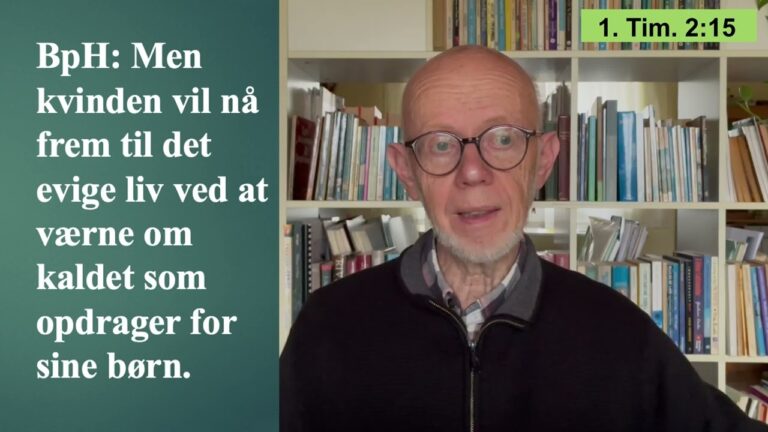
Iver forklarer et vers hvor nogle oversættelser ikke giver særlig meget mening: 1. Tim 2:15
Iver Larsen
 Video
Samtale
Undervisning
Difficult Passages #15 – Is Male Dominance God’s Design? Genesis 3:16 Explained
Carmen Imes